ACL 2020 · Semantic Models of Financial Markets
Stock Embeddings Acquired from News Articles and Price History, and an Application to Portfolio Optimization
The effect of news is separated from a prediction network into extractable and transferable stock vectors. The same representation explains news–price relations and enters a portfolio risk matrix directly.
A Prediction Model Is Not a Market Representation
Neural models that predict market direction from news entangle text, prices, and stock identity throughout their parameters. Even when prediction improves, they do not directly reveal which news matters to which asset, why assets share risk, or whether the learned relation transfers beyond the original task. This paper makes the stock itself a learnable object: every asset has a vector whose geometry is jointly supervised by news semantics and price movement.
The formulation also addresses the difficulty of short-term financial prediction. Explaining realized movement from contemporaneous information is a more controlled test of whether a model captures the relation between text and market behaviour. The paper separates a classification setting for learning the representation from a strictly historical prediction setting used only in downstream portfolio evaluation.
How a Stock Vector Selects News
Article is encoded as a key–value pair . Its relevance to stock is
The weighted news value becomes the stock’s market state:
The same news pool produces a different state for every stock. Because is trained through price supervision rather than a literal ticker match, it can select related articles that do not name the company. The stock vector grounds a financial symbol in external market behaviour.
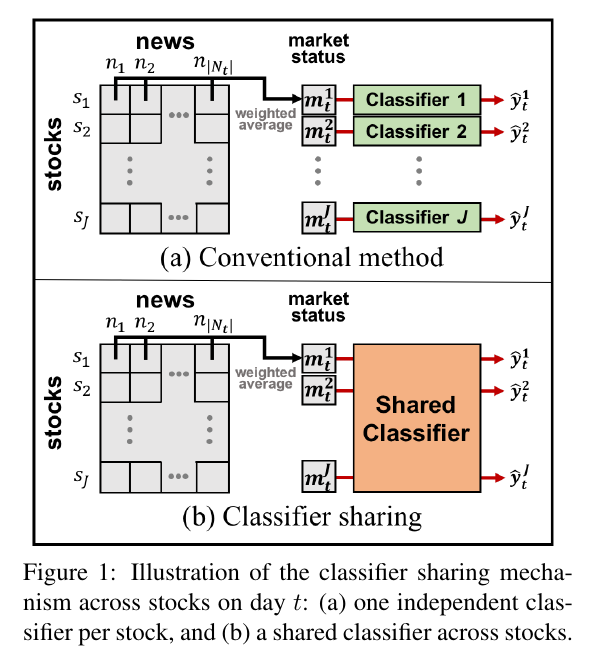
A Shared Classifier Addresses Small Samples
Daily observations give each stock only a few thousand supervised examples, making separate classifiers prone to overfitting. The model shares one Bi-GRU price-movement classifier across all stocks and expresses stock specificity only through in the news attention. The classifier’s effective sample size grows by approximately 50–100 times and can learn cross-stock structure.
Experiments use roughly 400,000 WSJ headlines and 550,000 Reuters/Bloomberg headlines, covering 89 and 50 S&P 500 stocks. Combining classifier sharing with key–value news representations reaches 68.8% mean classification accuracy on the full Reuters/Bloomberg data. Ablations show that the two mechanisms together resist limited-sample overfitting better than news weighting alone.
Transfer to Modern Portfolio Theory
The Markowitz mean–variance problem is
The standard risk matrix is estimated from historical return covariance and is sensitive to noise and finite windows. The paper constructs a risk matrix from cosine relations among stock embeddings and compares it with price-only covariance, Word2Vec, BERT, and simple text–price fusion. Each annual portfolio uses only data available before its test period.
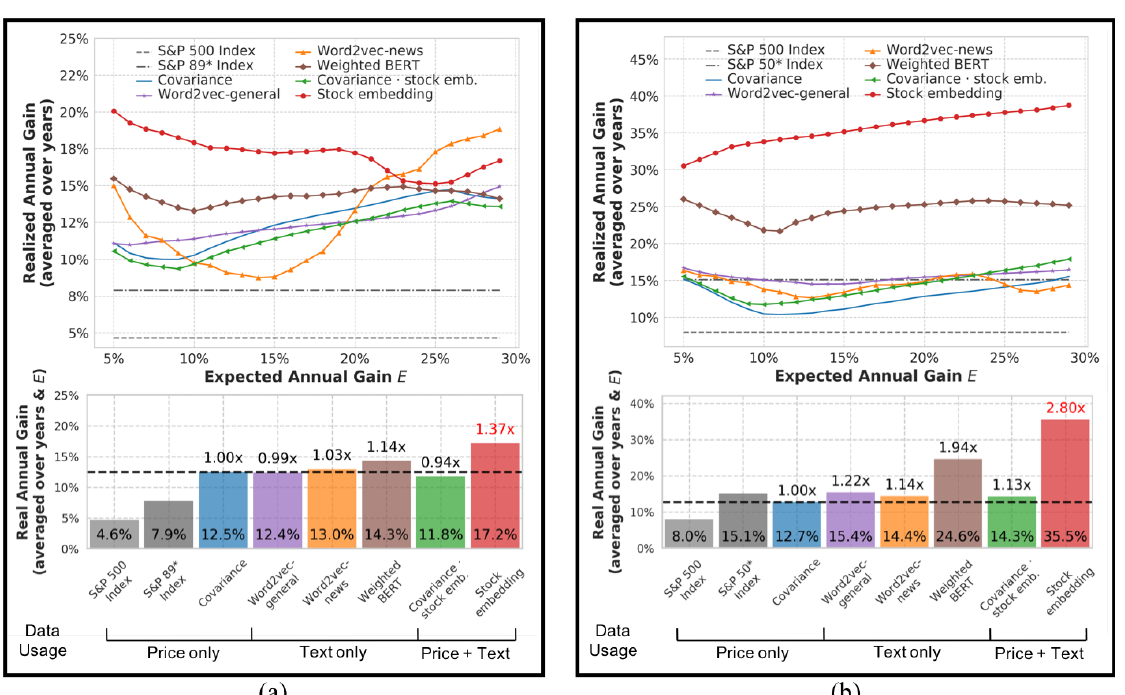
Stock-embedding portfolios outperform controls across most expected-return constraints. On Reuters/Bloomberg, mean realized annual return is 35.5%, compared with 12.7% for the historical-covariance baseline—a factor of approximately 2.8. Gains on WSJ are smaller but positive. Simply multiplying text representations with covariance is unstable; the useful geometry is the one supervised jointly by price movement.
Finding and Boundary
The contribution is not a fixed trading strategy. It turns intermediate knowledge in a financial NLP model into an operational object: stock vectors can be extracted, visualized, and inserted into an optimization problem outside the training classifier. This interface motivates later work on tail risk.
The results are annual rolling simulations on historical data and omit transaction costs, market impact, and many practical constraints. They are not guarantees of future returns. Contemporaneous news is used only for representation learning in the classification setting. The next question is whether text systematically supplements the rare events and structural changes that ordinary price covariance misses.