Semantic Models of Complex Financial Markets
A financial market is not merely a collection of price series. Firms, news, and extreme events form an interaction network through semantic relations; prices are a low-dimensional projection observed at trading times. We study how event structure in text can become a computable market representation for asset-relation modelling, portfolio construction, and tail-risk control.
Keywords financial NLP · stock embeddings · event semantics · Hilbert spaces · portfolio optimization · tail risk
From Price Prediction to Market Representation
Financial NLP often feeds news into a neural network to predict the next price direction. This has two limitations. Short-horizon direction is exceptionally noisy in an approximately efficient market, encouraging dataset-specific correlations. And even when prediction improves, the relation between text and prices remains distributed through network parameters and is difficult to transfer to risk analysis, asset pricing, or portfolio construction.
We change the learning target: the output is not the only object of interest; stock representations are learned explicitly. A ticker is no longer a discrete symbol but a vector constrained jointly by news semantics and price movements. The question becomes not only “will the price rise tomorrow?” but “how does news change the geometry among assets, and can that geometry support new financial tasks?”
News-Conditioned Stock Embeddings
In our ACL 2020 paper, each stock has a vector . Article is encoded as a key–value pair , and the inner product between the stock and news key determines relevance:
The news-weighted market state of stock at time is
The important object is the extractable interface between news and the asset. It can select relevant articles even when the ticker is not explicitly mentioned, while distances between stock vectors reflect sector, event exposure, and common price response.
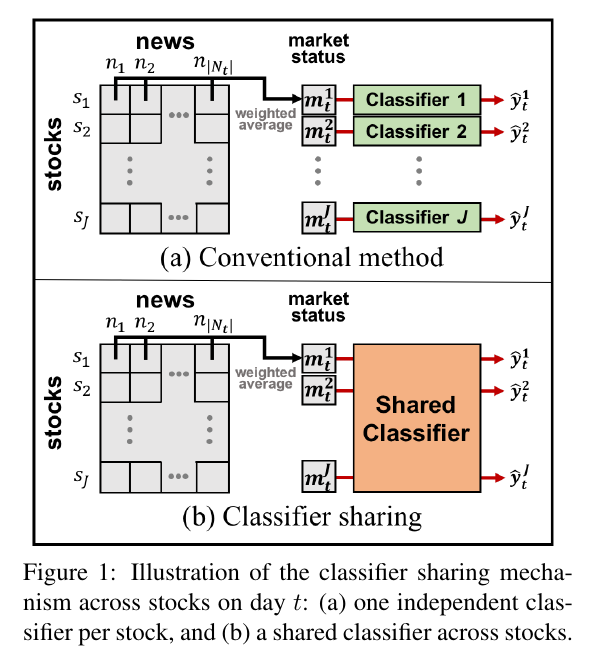
Daily supervision supplies only a small number of observations per stock. The paper shares one price-movement classifier across all stocks, keeping stock specificity in . This increases the classifier’s effective sample size by roughly 50–100 times. With a key–value representation of news, classification accuracy reaches 68.8% on Reuters and Bloomberg data. The task uses contemporaneous information to test whether the representation captures the relation between news and realized movement; it is not presented as a direct trading forecast.
Bringing Semantic Geometry into Portfolio Optimization
The Markowitz model uses historical return covariance :
Finite price histories poorly cover rare events and structural change. Stock embeddings supply an additional relation matrix. For , the normalized Gram matrix
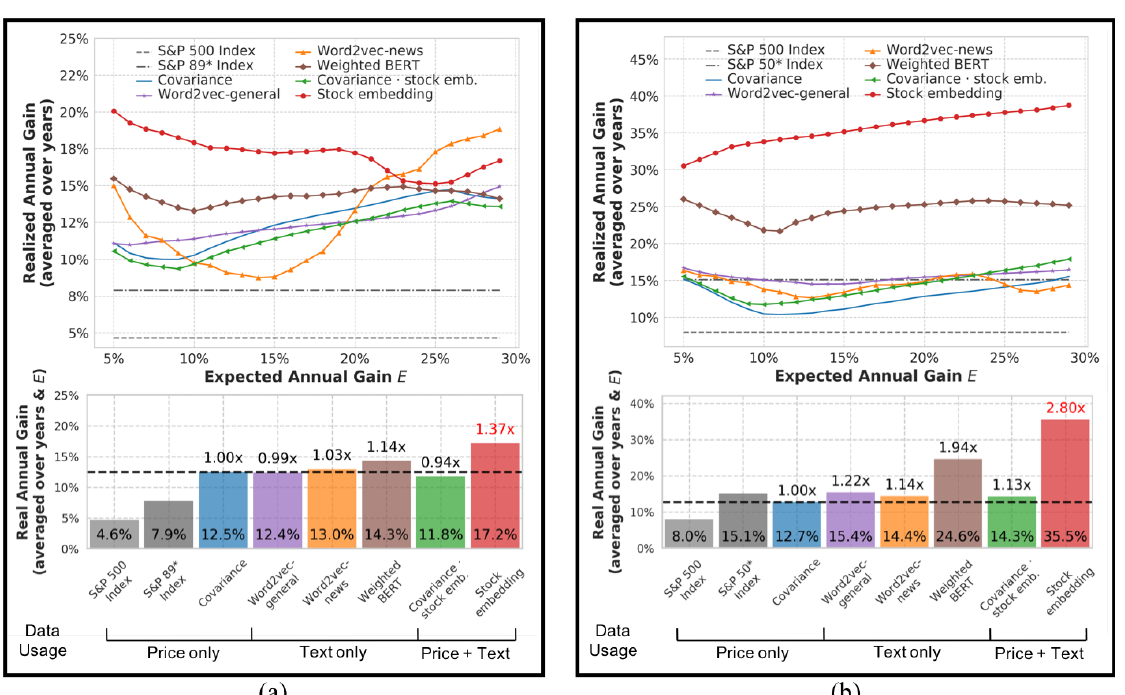
measures semantic correlation under joint news–price supervision. ACL 2020 uses this geometry in portfolio risk matrices. In strictly time-ordered simulations, portfolios built from stock embeddings achieve mean realized annual returns 2.8 times those of the historical-covariance baseline on Reuters/Bloomberg data. The point is not a fixed trading strategy, but the transfer of a learned text–price representation beyond its original classifier.
NESTED: A Financial Semantic Space over Event Distributions
Our Knowledge-Based Systems 2022 paper extends this representation into NESTED: NEws-STock space with Event Distribution. Stocks, articles, and latent events inhabit one inner-product space . Their relations are induced by event distributions rather than heuristic concatenation across data types:
This places text, prices, and events in a Gram geometry that can enter a quadratic portfolio objective. Covariance primarily describes co-movement under ordinary conditions. NESTED uses the selective recording of rare events in news to supplement tail relations that finite price samples estimate poorly. The semantic model is not an auxiliary sentiment feature; it becomes part of the risk geometry.
Tail Risk as a Semantic Problem
Financial returns are heavy-tailed. If portfolio loss approximately satisfies
then variance alone does not characterize extreme loss. Across 24 news–price datasets from three markets, NESTED increases the Pareto index of negative returns in every market, indicating lighter extreme-loss tails. Under a joint treatment of ordinary volatility and tail risk, the largest observed gains are 45.5% in return and 59.4% in information ratio.
Extreme events are sparse in price series but disproportionately recorded in news. This sampling bias is often treated as noise; for tail risk, it is structural information. The semantic space turns “which firms are exposed to similar events?” into a computable inner product, allowing low-frequency events to influence long-term risk allocation.
Boundaries and Applications
Applications include event-driven risk monitoring, cross-asset relation discovery, portfolio construction, and financial knowledge representation. Open questions include online evolution of stock states, separation of shared semantic exposure from causal influence, multiscale fields of policy and supply-chain events, and spectral changes in semantic relation matrices before market transitions.
Text does not remove market uncertainty. News sources are selective, backtests do not guarantee future returns, and embedding similarity is not causality. These models are best used as structural risk signals beyond price statistics—to make asset relations and extreme-event exposure more observable—rather than as deterministic price predictors.
Related Papers
Xin Du and Kumiko Tanaka-Ishii. Stock Embeddings Acquired from News Articles and Price History, and an Application to Portfolio Optimization — paper overview. ACL 2020. Paper
Xin Du and Kumiko Tanaka-Ishii. Stock Portfolio Selection Balancing Variance and Tail Risk via Stock Vector Representation Acquired from Price Data and Texts — paper overview. Knowledge-Based Systems, 2022. Paper